Empire Building Co. incorporated on April 14, 1927 by Charles H. (Bud) Ellis. He later owned the C.H. Ellis Co. and was the Potentate of the Sahara Grotto in 1965.
Cyclops Cyclecar Co. incorporated in 1914 and located at 2120 S. Meridian St. (rear). According to Wikapedia, the cyclecar was a light weight car that was a cross between a motorcycle and and automobile; it was mostly popular in the years before WWI. The Cyclops Cyclecar had only one headlight in the front middle, and only one prototype was assembled and then went out of business. The investors were James W. Smith – a mechanic from Indianapolis, Joseph W. Feree – a Danville, Indiana businessman, and Charles A. Hargrave – a college professor from Danville, Indiana.
Lew Wallace, Jr., an attorney, incorporated on October 13, 1905, and whose home was at 34 W. 11th St., Indianapolis. He was the grandson of the author, soldier, and diplomat Lew Wallace: the author of Ben Hur.
Circle City Brewing Co. incorporated in 1933 right after Prohibition ended, but never went into business. The incorporator was William R. Thurgood, and Indianapolis salesman.
Comet CycleCar Co., incorporated in 1914, and its office was at 308 Century Building, Indianapolis. Its directors were Fred P. Mertz – an auto salesman, and William H. Ogborn – an Indianapolis lawyer. Mertz designed the car and at least 20 autos were produced.
Columbia Dental College, incorporated in 1909 by Albert F. Eiteljorg at 1 E. Market St., Indianapolis. Albert was born in 1868 in Germany and lived at 821 N. Pennsylvania Ave. He was the father of Harrison Eiteljorg, an Indianapolis businessman and philanthropist, and whose art collections became the Eiteljorg Museum of American Indian and Western Art located in downtown Indianapolis.
Cinetrope Corporation, incorporated in 1931 by Russell W. Langsenkamp, president of the Sono Equipment Corp.: a motion picture apparatus company i Indianapolis. I think a “cinetrope” was a circular animation machine.
Diplomat Opera Company, incorporated on May 12, 1908, located at 1919 N. Delaware St. The directors were Willard W. Hubbard – a coal company owner, Michael J. Ready – a paving company owner, William Kather – a wholesale grocer, Sol. S. Kiser – the V.P. of the Meyer-Kiser Bank, and Barley Walker – a streetcar engineer. What do these men have in common?: possibly enough time to be interested opera!
Electric Vehicle Service Co., incorporated on June 5, 1913 at 648 N. Meridian St.: the southwest corner of Meridian & Walnut Streets. “Buying and selling of electric vehicles of all kinds and their supplies.” The directors were William Conrad Brooks – a chemist, Ray Thomas Watts – an electrical engineer, and their spouses : E.J. Brooks and C.C. Watts. This must have been a venture in electric automobiles before the combustion engine became dominant.
Electric Crosstree Manufacturing Co. incorporated in 1917 by three men from Chickasaw, Mississippi. Their purpose was “to manufacture crosstrees for telegraph wires”.
E. Buchanan Manufacturing Co., incorporated on November 25, 1919 by three men from Virginia. Their purpose was “to manufacture steam engines”. Again, their interest was probably to develop steam engines for automobiles, or at least to compete with gasoline-run engines.
Electric Soap Manufacturing Co., incorporated on October 4, 1883. The purpose was “to manufacture soap and toilet articles”. An advertisement stated that “Electric-Light Soap is the best laundry soap made. Prepared by an entirely new method. Composed of the purest material. Will not injure the fabric. Will cleanse fabrics without rubbing. Enquire of your grocer”. The directors were Elias C. Atkins – owner of the E.C. Atkins Sawworks Company (one of the biggest employers in Indianapolis at the time), Leolin E. Boswell – a soap maker, William Olds – a soap manufacturer, Charles A. Shotwell – a grain dealer, and Oliver Mousey – a banker.
E.M. Chemical Co., incorporated in 1916. Its purpose was “to manufacture a patented compound for repairing and mending automobile tires, known and designated as ‘vulcatite'”. The directors were D.C. McRoberts – a chemist at the G.&J. Tire Company, W.A. Engelhard – also worked for a tire company, and W.B. Denison – Secretary & Treasurer of the Cotton Belt Land & Development Company.

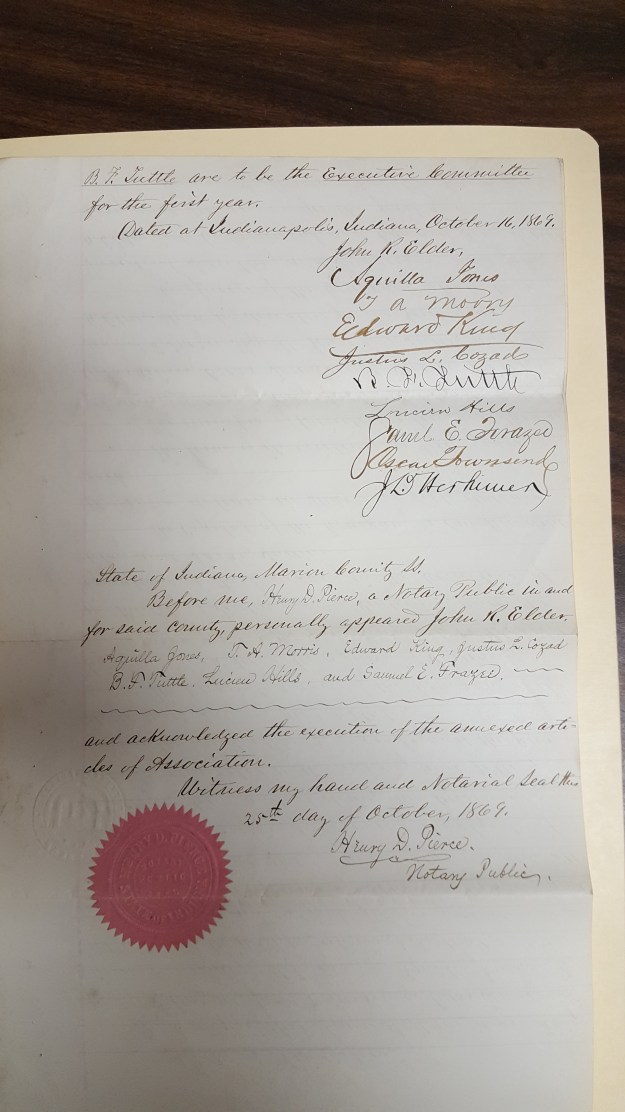
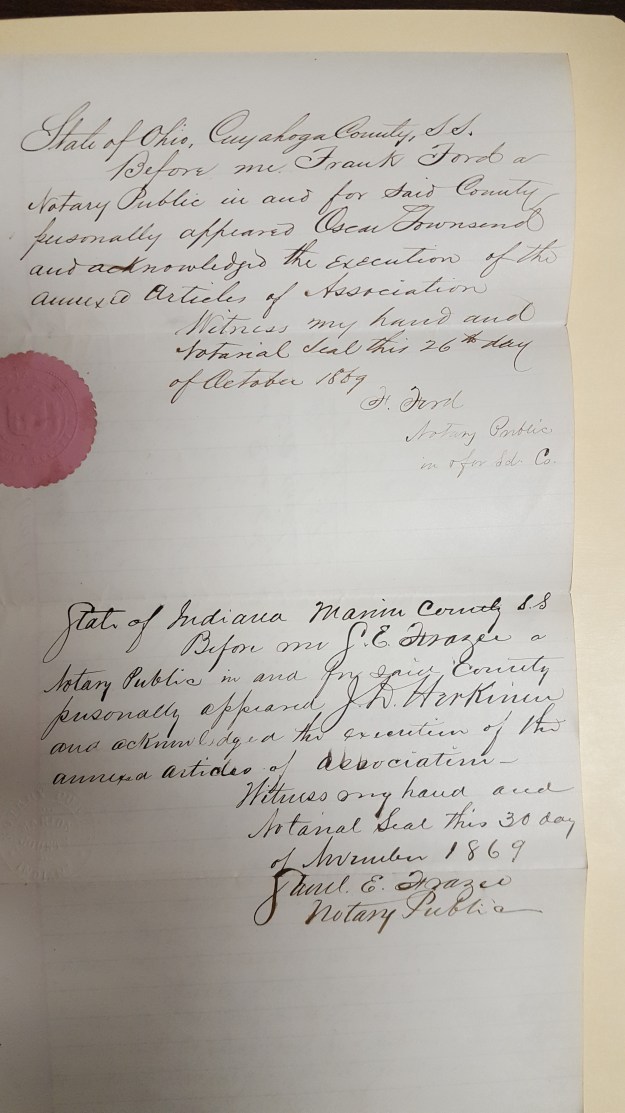 Carbon Block Coal Co, incorporated in 1869 with Thomas A. Morris as President. At the time Morris was President of the Indianapolis & St. Louis Railroad.Morris and his associates must have set up this coal company to supply the fuel for their railroad. Morris had a varied and successful career up to this time, and was to accomplish more. He graduated from West Point in 1834, was an engineer on the expansion of the National Road through Indiana; he was the supervisor for the construction of the Central Canal through Indianapolis, as well as for the Madison & Indianapolis Railroad, finished in 1847. He was a Union Brigadier General during the Cviil War. He supervised the building of the Indiana State House, finished in 1880, and the Union Depot. He later was made President of the Indianapolis Water Co. to straighten out its muddled mess. Indianapolis would not have been the same without his works. The other directors of this coal company were local railroad executives and businessmen, including John Elder, the former editor of the Locomotive Newspaper.
 Central Oil Co. Incorporated in 1900. Its purpose was to drill for oil. Its investors were Dudley H. Wiggins – a farmer, George E. Hume – secretary of a Title Co., John G. Walleck, William E. Wocher – an insurance agency manager, and Newton B. Tarkington. This last signer was the famous Hoosier author Booth Tarkington, early in his career. It is interesting he later wrote that he detested the pollution caused by industry and automobiles.