Apperson Brothers Automobile Company

The Apperson Brothers Automobile Company was incorporated in Kokomo, Indiana on November 9, 1908, and its paperwork extended to 1925. Its original directors were Elmer Apperson, Edgar L. Apperson, Alton G. Siberling and C. H. Felske

The object of this corporation was “to manufacture automobiles, motor cycles, all self-propelled conveyances, and all accessories thereto and machinery connected therewith.” The name of the company was changed to the Pioneer Automobile Company on October 13, 1924.

Elmer Apperson was born in 1861 and his brother Edgar in 1870. Elmer opened a machine shop in Kokomo, Howard County, Indiana in 1888 and his younger brother later joined him.  Elwood Haynes, a Kokomo inventor, got the idea of attaching a gasoline fueled marine motor to a carriage and asked Edgar to help him with the project, which they finished and tried out successfully on July 4, 1894. Edgar continued to work on the idea, and together Haynes and the Apperson brothers formed the Haynes-Apperson Company, slowly producing some of the first automobile models in the United States.

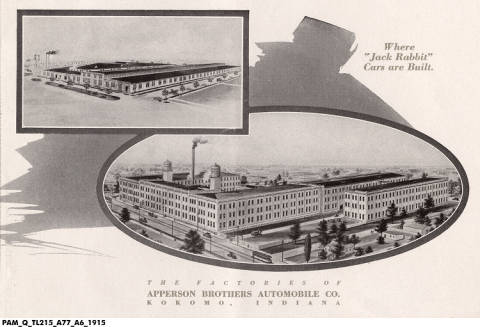
The partnership split in 1901, though Haynes did not drop the Apperson name until 1905. The Apperson factory, which was located near Wildcat Creek in Kokomo, burned down and a new plant was built in 1906 on Kokomo’s South Main Street.  A bigger plant was built on Washington Street in 1916. They incorporated their company as the Apperson Brothers Automobile Company in 1908. Besides the Appersons, an original director was Alton G. Seiberling, an investor who became the company’s secretary and treasurer till 1912 when he joined the Haynes Automobile Company. Also, Charles H. Felske, a local factory manager, was an original director.

Instead of delivering their purchased autos by train, they would drive the autos to the purchasers and personally show them how to drive and maintain the auto. One delivery to Brooklyn, N.Y. took 21 days! They also would participate in various kinds of races around the country to publicize their product. In 1907 they introduced their Jackrabbit model which became their most popular auto.
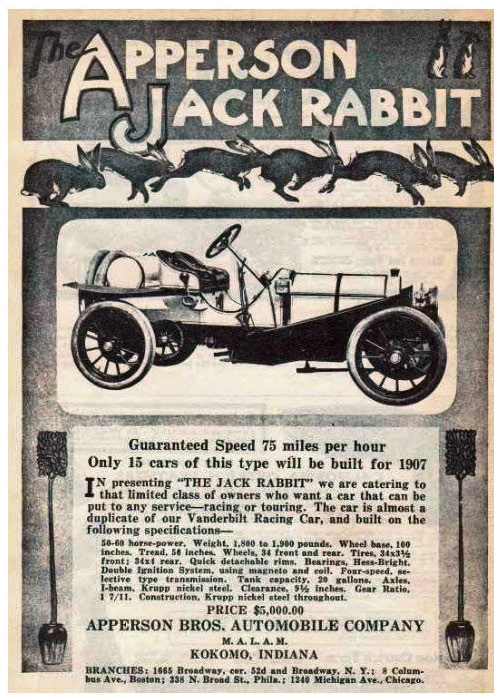
2017-01-16_20-04-47_edited-2Elmer died in 1920 and Edgar sold his stock in the company and retired from the business in 1924 when the company was in financial trouble. It went bankrupt in 1926. Though, according to the corporate papers, Edgar was a director in the newly formed Pioneer Automobile Company, but it was not successful. It is interesting that the treasurer of the Apperson company, A. G. Dawson, and the company’s Vice President, B.C. Buxton, hung in as directors of the Pioneer Company, along with E. B. Barnes, a local lawyer, and three out-of-town investors. The company must have had too much debt.

Edgar Apperson retired to Arizona to become a farmer, and his hobbies were hunting and fishing. He died in 1959.

by Robert F. Gilyeat, an Indiana State Archives volunteer


An association of 7 Indianapolis 500 Mile Race drivers in 1935.

20180605_162021.jpg

Champion Drivers, Inc. was a company incorporated by Wilbur Shaw, Peter DePaolo, Fred Frame, Al Gordon, Louis Meyer, Lou Moore, and Elbert Babe Stapp on June 7, 1935. They all were Indianapolis 500 Mile Race drivers, and they all claimed Indianapolis as their place of residence.

“The purpose or purposes for which it is formed are as follows: To engage in automobile racing, including the owning of racing automobiles, promoting automobile races and contracting for the same; also contracting for the services of drivers and mechanics for the operation of racing automobiles.”

Wilbur Shaw was a legendary race car driver who first participated in the Indianapolis 500 Mile Race in 1927 and won it in 1936, 1939 and 1940. He helped to save the race track grounds from housing development after WWII and became the track’s president. There are several informative sites about Shaw on the internet.

Peter DePaolo, whose uncle Ralph DePalma won the Indianapolis 500 in 1915, competed in seven of these races, and won in 1925. After suffering from a coma from a race crash in 1934, he owned and managed the winning car in the Indianapolis 500 in 1935. Its interesting that he signed the paperwork for the Champion Drivers company about seven days later. He later became a very successful sprint car owner.

Fred Frame began his career as a dirt track racer, and participated in eight Indianapolis 500 races, winning it in 1932. Al Gordon raced in the 500 in 1932, 1934 and 1935, but was killed in a race crash in 1936.

Louis Meyer, another racing legend who began the tradition of drinking milk from a milk bottle after winning the Indianapolis 500, won the race in 1928, 1933 and 1936. Lou Moore, also a racer, was more successful as a car owner winning five Indianapolis 500 races. Elbert “Babe” Stapp raced in twelve Indianapolis 500 races, and later became more famous as sprint car racer.

There were no more annual reports sent to the State after 1935 by Champion Drivers, Inc., so they probably didn’t continue this association. But this attempt at financial cooperation between these very successful race car drivers is intriguing, and probably unprecedented.

by Robert F. Gilyeat, an Indiana State Archives volunteer

An Early Weight Reducing Machine

c100_2015_mch_002_0000Gardner Weight Reducing Company, June 22, 1916, South Bend, Indiana
“The objects of this association shall be the purchasing, selling, leasing and operating Body Massage of Reducing Machines.”

The directors of this company were Richard O.Morgan, Katherine Morgan, James A. Judie, and Margaret Judie. Mr. Morgan was a credit man [accountant?] at the Oliver Chilled Plow Works, one of South Bend’s largest factories, and Katherine was his wife. Mr. Judie was a real estate agent, and Margaret was his wife.

The Gardner Weight Reducing Machine was one of the first mechanical massage machines, using the theory that massaging the body will increase the body’s circulation which will cause fatty tissue to burn off. Similar to later fat-reduction vibration machines, the Gardner machine used roller-pin shaped rollers to massage the patient’s midwaist. A picture of the machine shows a crank on the right side, so maybe an attendant had to crank it to make it work. “Instead of rolling on the floor”!?

James P. Gardner and his son Paul E. Gardner manufactured this weight-reducing contraption. James was a very wealthy fifty-seven year old manufacturer of machines who lived with his family and several servants on Greenwood Avenue in Chicago. Paul was about twenty-five years old and worked as a stocks and bonds broker. Apparently the machines began to be used in Chicago and several other cities in the U.S. early in 1914, and men and women used them in separate rooms.

The elder Gardner was also a co-founder of the Olympia Field Country Club in Chicago, which boasts the largest clubhouse in the United States. I bet the Gardner Weight Reducing Machine had a prominent place in it’s gymnasium!

by Robert F. Gilyeat, an Indiana State Archives volunteer

Peoples’ Cooperative Telephone Company


20180607_164044 (1)

I have come across many independent telephone systems in rural parts of Indiana incorporated during the early 1900s. The Peoples’ Cooperative Telephone Company, headquartered in the village of Bowers, Montgomery County, Indiana, was incorporated on January 8, 1902, and reincorporated on November 10, 1922. This is an unusual example because the company stayed in existence to 1945. Most of the independent telephone companies lasted maybe ten to twenty years. Also, many of their incorporation papers would have dozens of subscribers’ signatures, whereas this document was signed only by the five directors and did not include the rest of the subscribers to the telephone system. Also note that this incorporation document was very primitive; I doubt if a lawyer was ever consulted.

“The said Corporation proposes to establish, maintain, and operate Telephone lines and Exchanges in the counties of Montgomery and Boone in the state of Indiana, with exchange at Bowers, Indiana. [ Bowers was a railroad stop and was also named Bowers Station.]The amount of capital stock of this company is $600.00, and is divided into 150 shares.” The 1922 reincorporation explained that each share cost $4.00. Also, the 1908 corporation report stated that the use of the system for each subscriber was raised to 10 cents. I wonder if that meant 10 cents per call?

The original directors of the Company were Martin L. Clouser – a farmer who lived in Thorntown, Montgomery County, and was the manager of the Company through 1940 when he was 70 years of age. His wife Goldie was the Company’s bookkeeper. John H. Hutchison – in 1903 he was listed as the Postmaster of Bowers with an annual salary of $138.95. He later moved to Morgan County, Indiana, where he worked as a farmer. Lewis Kirk – he was a farmer and machinist who owned several thrashing machines, and also an oil drilling business. George W. Deck and Marshel Hampton were farmers in Bowers.

by Robert F. Gilyeat, an Indiana State Archives volunteer


Horse Thief Detective Agencies

20180722_1435371237340536.jpg

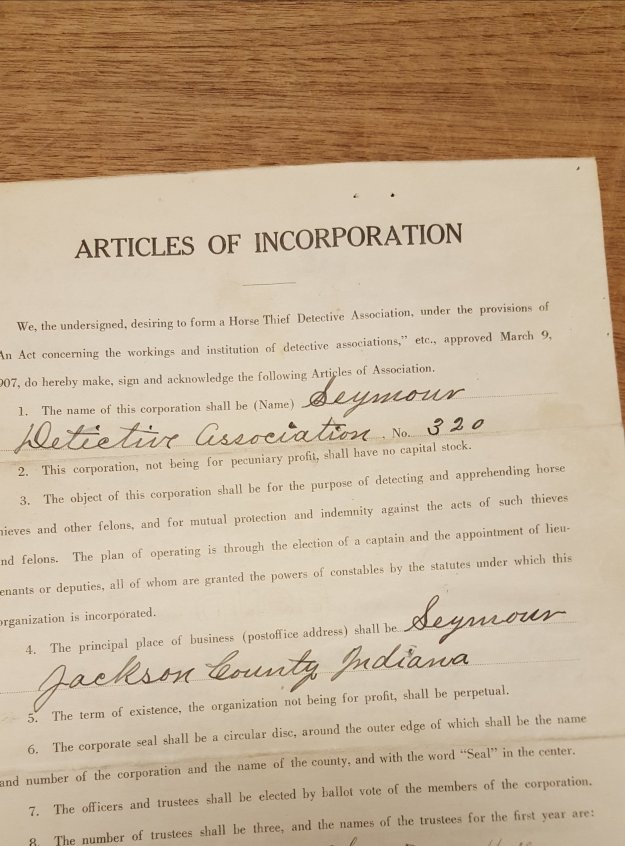
Seymour Detective Association No. 320. Seymour, Jackson County, Indiana. June 18, 1923. “The object of this corporation shall be for the purpose of detecting and apprehending horse thieves and other felons, and for mutual protection and indemnity against the acts of thieves and felons.” This was a “fill in the blanks” form letter that also described the organization of the Company as containing a captain, lieutenants, and constables. There were ten signatures on the second page of this document, which I believe was the minimum membership for a company. Also, the Horse Thief Agency Association was only formed in the state of Indiana.

According to the Biennial Report of the Secretary of State of Indiana for companies incorporated in Indiana there were 123 of these vigilante companies formed between November 1, 1906 and September 30, 1908. In comparison there were only nine new Detective Association companies in 1918, according to the Journal of the Fifty-Eighth Annual Session of the National Horse Thief Detective Association held in Richmond, Indiana on October 1-2, 1918. This Journal also claimed there were 8,810 members of the Association at that date, and that 5  horses, 14 autos, 18 sheep, and 1 robe [?] had been recovered that year. Some of the Companies had descriptive names such as the Good Intent Horse Thief Detective Association No. 159, the Invincible Detective Association  of Koscuisco County, Ind. No. 29, and the Young America Detective Association.

The Association’s 1918 Annual Journal also chronicled a large get-together which included a patriotic speech and an appreciation of participation in the meeting by a twelve-year old girl. With a membership of 8,810 and only 38 recoveries made by them in 1918, one wonders if the Association wasn’t more of a social association than a detection and apprehension organization.

There is discussion about whether and when this Association, formed in Indiana in the decade before the Civil War, morphed into a white supremacy group.  When the KKK became dominant in Indiana politics in the 1920s, they infiltrated the HTDA. An Indiana state law allowed members of the Association to travel across state lines to chase and apprehend felons, including “nomadic band[s] of gypsies” and those who “live in idleness, having no visible or known means of earning a fair, honest and reputable livelihood”. This phrase could be broadly interpreted and I can see why the KKK would want to participate in this organization.

There were a few Horse Thief Detective Agencies formed in the early 1930s for some reason, but the organization had died out by then.

by Robert F. Gilyeat, an Indiana State Archives volunteer


Hack & Simon Brewery, Vincennes, Indiana

eagle2eagle3eagle1

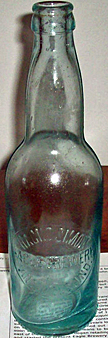
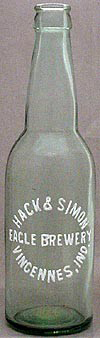
Hack & Simon Brewery Company, Vincennes, Indiana, June 20,1916 to 1940, located on Indianapolis Ave. between North 3rd and North 4th Streets. “The objects and purposes of the corporation are the manufacture, sale, bottling, and disposition of beer, the carrying on, owning and operation of a brewery.” The original 1916 directors were Julius M. Hack, Dorothea Hack, Louis J. Hack, Anton Simon, and Frank W. Bloom. E. W. Determan became a director in 1919.

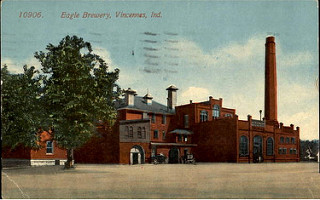
According to the National Register of Historic Places Inventory Nomination Form for the Hack & Simon Office Building in Vincennes, Indiana, John Ebner opened the Eagle Brewery in 1859. Ebner was born on June 8, 1817 in Alsace, France where he learned the miller and bakers’ trades. He served in the French Army for 5 years in Africa as a baker. He then immigrated to the United States in 1846 and eventually ended up in Vincennes, Indiana in 1849 where he started a bakery, grocery store, and an ice making company. He opened the Eagle Brewery in Vincennes in 1859-1860 until 1870 when he began to lease the buildings to different brewers. The 1880 Federal Census showed Ebner as a saloon keeper, and he also continued to operate his ice company. John Ebner died on January 26, 1889.

30984031171_edd8332363_nEugene Hack was born in Wurtenberg, Germany in 1842 and immigrated to the United States in 1867. He was a grocery store clerk in Vincennes before he and Anton Simon bought the Eagle Brewery. Anton Simon was born in Chamonix, France in 1850 and arrived in the United States in 1868. They purchased the Eagle Brewery in 1876, rebuilt the plant, and reopened it as the Hack & Simon Eagle Brewery. They increased the brewery’s capacity to more than 25,000 barrels a year and employed over 25 people, selling to an extensive region around Vincennes, Indiana. They built the Hack & Simon Office Building in 1885, which is now on the National Register of Historic Places.
Of the 1916 directors of the brewing company, Julius M. Hack was the son of Eugene Hack and was born in 1876. In the 1910 Federal Census he is listed as a clerk in the brewery, and in 1920 as secretary of the brewery. Dorthea Hack was his mother. I’m not sure how Louis J. Hack was related to the family, but he did not live in Vincennes. Frank W. Bloom was the company’s bookkeeper.

E.(Ernest) W. Determan was born in Hanover, Germany in 1862. In 1900 and 1910 he is listed as traveling collector for the brewing company, and in 1920 he was a traveling salesman of “soft drinks”. A July 29, 1919 amendment to their incorporation statement stated they “changed from operation of brewery to Industrial Distillers”, “the doing of all such acts as may be appropriate or necessary for the successful and economic conduct of business.”  The term “industrial brewing” usually meant to make the brewing process more efficient and increase output. This amendment was a reaction to the Wartime Prohibition Act that took effect a month earlier on June 30, 1919 prohibiting the brewing of alcohol content greater than 1.28%. The National Prohibition Act went into effect on January 17, 1920 which prohibited the selling of alcoholic content above .5 %.

The company’s 1928 Corporation Report stated “Our plant closed down on January 1, 1928”, but they continued to send in Corporation Reports through 1940. The 1940 directors were Julius M. Hack – President, Otto Hack – Vice-President, and Marie C. Simon Secretary-Treasurer. The Brewery reopened in 1934 after the Prohibition amendment was repealed on December 5, 1933. I’m not sure how long the brewery stayed open then, but its office building was sold to Vincennes University in the early 1950s, and the brewery’s plant has been demolished.

by Robert F. Gilyeat, an Indiana State Archives volunteer


Depauw College

In 1852 the Indiana Methodist Conference founded the Indiana Asbury Female Seminary in New Albany, Indiana. During the Civil War the school suffered financially and lost its property in 1866. The organization of Indiana Methodists then started a fund-raising campaign to buy the property back. A local wealthy businessman, Washington C. Depauw, then contributed an ample amount of money to repurchase and to rebuild the Seminary; In 1867 the Indiana Methodist Conference renamed the school the Depauw College for Young Women in the benefactor’s honor. Its interesting that the Indiana Asbury University in Greencastle, Indiana, also began to admit women to their school in 1867. Indiana Asbury also changed its name in 1884 to Depauw University when he donated a large amount of money to the school.

“At the 36th annual session of the Indiana Conference of the Methodist Episcopal Church, begun and held at Welsey Chapel in the city of Indianapolis, County of Marion, State of Indiana, Wednesday September 11, A.D. 1867, … The following among other proceedings were made…On motion of the Revd Kiger it was unanimously Resolved, That the Indiana Conference of the Methodist Church make the following statement and declaration….

First. That it is the intention and immediate determination of said Conference to establish in the City of New Albany Floyd County Indiana an institution of learning for females (for some reason “for females” is crossed out) in the higher walks of literature … Second. That the name and style of said Institution shall be the Depauw College (several words were erased before the new name of the college). Third. That the endowment of said college shall be such as the Conference can provide, or the friends of said College may from time to time donate thereto, not to exceed One Hundred thousand dollars. Fourth. That said endowment when provided shall be so administered as the principal thereof shall remain a perpetual fund alone shall be currently used for the purposes of said college and for the advancement and encouragement of female (“female” crossed out) education. Fifth. That the real estate and College Buildings now owned by said Conference and situated in said city and purchased with funds donated for the purpose, by friends of said institution, is now north about the sum of Forty thousand Dollars.

In testimony whereof the President and Secretary of said Conference hereto submit their names, done at said city on the day of first aforesaid,

F.A. Morris, Bishop of the M.E. Church and President of said Conference

Stephen Bowers, secretary of said Conference”

The church where this conference was held in 1867 was Welsey Chapel, situated on the southwest corner of the Circle, Indianapolis, Indiana. The College was located at East 9th & Main street in New Albany, Floyd County, Indiana. After the College was financially saved it became known as the Depauw College for Young Ladies.  It later became known as the Depauw College for Young Men and Women. Maybe that is the reason for the words “for females” and “female” being later crossed out in the incorporation papers. This College closed in the early 1900s.

Syracuse Electric Tablet Company, 1907-1926

The Syracuse Electric Tablet Company was incorporated from 1907 to 1926, in Syracuse, Kosciusco County, Indiana. The stated object of the company was “to buy and sell retail and wholesale medical preparations and other merchandise.” The company’s directors were John W. Rothenberger (president), and E. Mae Tish, both of Syracuse; William H.H. Angel of Cromwell, Indiana; George H. Lehman of Kendallville, Indiana; and Eli Schlotterback of Ligonier, Indiana.

Rothenberger, Tish, Angel and Lehman were all born in the early 1880s. According to the Federal Census Rothenberger began as a furniture dealer in 1900, and undertaker in 1910 and 1920, and a real estate salesman in 1930 and 1940. The Syracuse-Wawasee Museum contains a footstool, a rocking chair, and a Victrola cabinet made by him. Mae Tish was Rothenberger’s bookkeeper when he was an undertaker. Angel’s occupation was usually listed as a farmer, but in 1910 he listed as a dynamo engineer (electrical engines?), and as a carpenter in 1930. Lehman sold tombstones in Ohio in 1910, but became a poultry farmer in Indiana. Schlotterback was born in the early 1840s and served in the 30th Regiment Indiana Infantry during the Civil War. This Regiment’s first battle was at Shiloh, and continued fighting in major battles through 1865. He then worked as a physician in Ligonier, Indiana until he died in 1912.

The name of this early 20th Century company, the Syracuse Electric Tablet Company, is startlingly modern, but apparently is connected to the medical profession. The best guess is that this was an electrical device that made tablets (pills). The probable connection between the investors was that Schlotterback, being a physician, and Angel a sometime electrical engineer, probably came up with idea for this pill-making electrical device; and Rothenberger, Tish and Lehman, being remotely connected in the undertaking business to the health business, probably provided early investment money. Wouldn’t they be surprised about the future meaning of “electric tablets”?

Equal Suffrage Association of Indiana

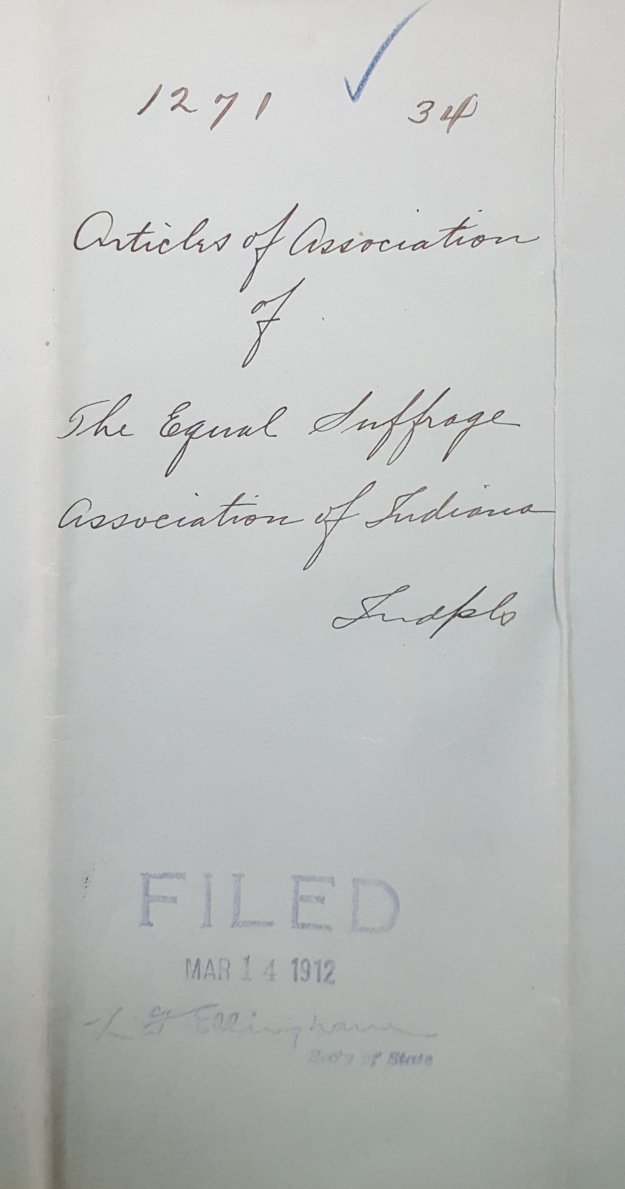
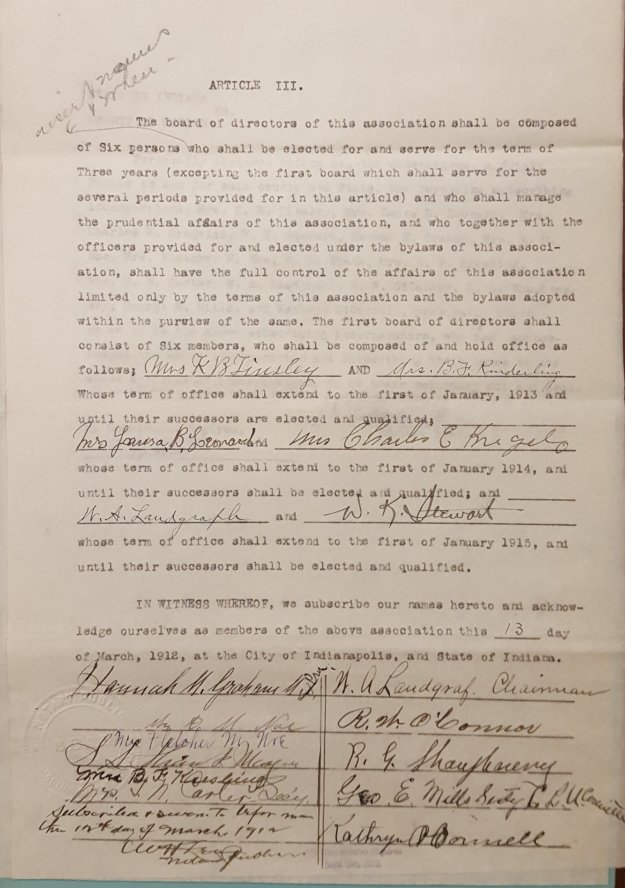
The Equal Suffrage Association of Indiana was incorporated on March 14, 1912. Its objective was “To advance the industrial and legal rights and political education of men and women, and to secure equal suffrage to them by appropriate state and national legislation; to organize and direct Branch associations and to create a public sentiment in favor of the rights of all people.”

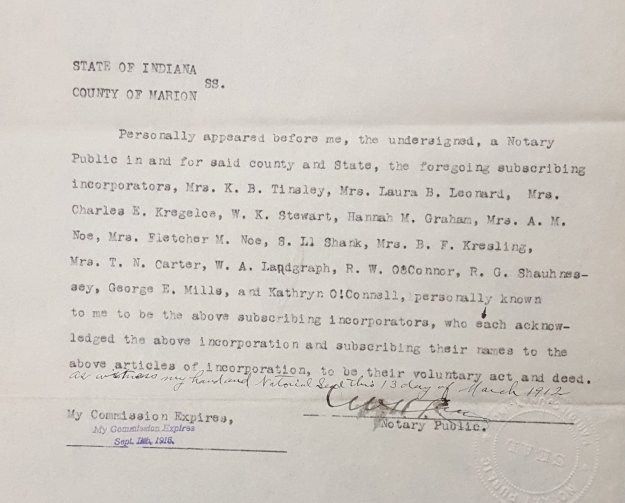
The Directors were: 1)Dr. Hanna M. Graham – President, she was born in 1874 at Tuscola, Illinois, of British immigrant parents. She graduated from the Medical School Central College in Indianapolis, IN in 1897, and specialized in the treatment of diseases of women and children from 1897 to 1929. Her home was at 2233 North Meridian St. In 1914 she organized the Indianapolis Women Physicians’ Club, an organization of twenty-five women physicians whose goal was to establish a children’s hospital in Indianapolis. This was about two years before the Riley Memorial Association was formed by prominent Indianapolis citizens for the formation of the Riley Children’s Hospital which opened in 1924. Dr. Graham passed away in 1929.

2) Mrs. Laura B. Leonard – wife of a Marion County deputy sheriff; 3) Kathryn O’Connell – a nurse at Methodist Hospital; 4) Mrs. Fletcher M. Noe – wife of an Indianapolis jeweler; 5) S. L. Shank – the Mayor of Indianapolis; 6) William K. Stewart – President & Treasurer of the W.K. Stewart Company, a bookstore located at 9-11 West Washington Street; 7) George E. Mills – a piano salesman; 8) William A. Landgraff – chairman of the association, an Indianapolis tailor; 9) R. W. O’Conner – an Indianapolis tailor; 10) Mrs. Albert M. Noe – (Hattie) widow of an engraver and mother of Fletcher M. Noe; 11) Mrs. K. B. Tinsley – wife of a physician; 12) Mrs. Charles E. Kregeloe – (Laura) widow of a funeral director; 13) R.G. Shaughnessy – linotype operator; 14) Mrs. B.F. Kresling; 15) Mrs. T.N. Carter.

Its interesting that about this time Mayor Shank, a signer of this incorporation, was asked to appoint a woman as Mayor for one day, and he chose his wife, Sarah. An article in the Indianapolis Star on October 11, 1910, stated that Dr. Amelia Keller was President of the Equal Suffrage Association.( Dr. Keller later became President of the Women’s Franchise League of Indiana in 1911.) The Association was to meet during the spring and summer on the second Monday of each month, and Dr. Hannah Graham would send out postal cards “for the purpose of gaining membership to the Suffrage Association.” Women gained the right to vote in Indiana in January 16 1920, when the Indiana Legislature ratified the 19th Amendment to the U.S. Constitution.

Polks Indianapolis City Directory 1914

20191022_0049571121294456.jpg

20191021_230649197573807.jpg


by Robert F. Gilyeat, an Indiana State Archives volunteer

Bureau of Legal Aid

Bureau of Legal Aid, October 25, 1927 – 1943, 229 1/2 Indiana Avenue, Indianapolis, IN

a) To furnish legal aid to deserving persons who are financially unable to secure same.

b) To offer Mediums of reducing needless litigation.

c) To protect poor persons in trouble from the graft of professional bondsmen.

d) To educate the people whose lives it touches to the obligations of the law and their duties in respect to same.

The directors in 1927 were:

A. H. (Arnold Hamilton) Maloney – this was a very remarkable man who lived in Indianapolis for several years. Dr. Maloney was born in Trinidad, British West Indies on July 4, 1888. His genetic heritage was African, English and Irish. He graduated from Naperina University, Trinidad, in 1909. After visiting an uncle in New York, he attended Lincoln College in Pennsylvania where he won an oratorical contest. This experience led him to the ministry in the Episcopal Church and he earned an A.M degree from Columbia University. In 1913 he became pastor of the all-black St. Phillips Episcopal Church in Indianapolis at 702 N. West Street.

In his Autobiography, “Amber Gold”, published in 1946, Dr. Maloney gives very few details about his experiences in Indianapolis other than to say that the other Episcopal congregations in Indianapolis had little to do with his congregation, and that at Church conferences he found other Episcopalian ministers were not very well educated. While in Indianapolis he wrote a column in the Indianapolis Recorder about local race relations, and later wrote a book, “The Essentials of Race Leadership”. Besides his church duties he worked as the education secretary at the YMCA at 450 N. Senate St. for which he was criticized by his superiors. This caused him to resign in frustration.

Dr. Maloney then taught Psychology at Wilberforce University from 1920 to 1925, earned a medical degree from Indiana School of Medicine in 1929 and a PhD. from the University of Wisconsin in1931. Howard University hired him as head of its Department of Pharmacology in 1931 where he enjoyed doing research and became well known as the discoverer of an antidote for barbiturate overdose. In his autobiography he wrote much about his love of books. He died in 1955.

Beatrice P. (Pocahontas) Maloney – Beatrice and Dr. Maloney married in Indianapolis in 1916. She was a native of Kentucky and was about ten years younger than him. She stayed in Indianapolis while she raised their two children and worked as a clerk (secretary?) at Crispus Attucks High School. She moved to Washington D. C. when Dr. Maloney was hired at Howard University. Lula Hodge was the wife of Warren Hodge, the Pastor of First Free Baptist Church.

There was no paperwork in this file between 1927 and 1943, so I couldn’t identify other directors at the Bureau of Legal Aid during the intervening years. In 1943 the directors were Rev. E. D. Hadley – a teacher at a private school, Tull E. Brown – a grocery store proprietor, and William S. Henry – a lawyer with his own practice. This free legal service for the Indianapolis black community must have served an important need during these sixteen years at their location at 229 1/2 Indiana Avenue.

By Bob Gilyeat, Indiana State Archives volunteer